
Roof Raiders
Thursday 1 December, 2005, 09:38 - Pirate/Clandestine
Towards the beginning of November this year, Ofcom conducted a massive series of raids on pirate radio stations in London, and event considered news-worthy even by the BBC.The operation closed 53 pirate FM stations in London and whilst some of the bigger stations are now back on-air, for some stations, losing a transmitter may mark the end of their broadcasts for some time. One station (On Top FM) also had a studio raid which can be devastating, and is certainly much more difficult to recover from.
What is interesting about this surge of activity by Ofcom is not that it was long overdue, or that it was so widespread, but was some of the 'anti-pirate' propaganda that Ofcom, a supposedly respectable body, spouted in their press release.
"Illegal broadcasting causes interference to the radios used by critical safety of life services such as the London Fire Brigade and National Air Traffic Services (NATS)."
 Let's examine this statement. The London Fire Brigade uses frequencies of 70.5 - 71.5 MHz paired with 80.0 - 82.5 MHz, 148.825 MHz (for pagers), various frequencies between 450 and 453 MHz paired with 464.9 - 467.9 and 457 - 457.5 paired with 462.5 - 463 MHz. Now unless I am mistaken, none of these frequencies are directly affected by transmissions in the FM band (87.5 - 108 MHz) otherwise they would receive interference every day from the legal stations. Indeed other than for the fourth harmonics of transmitters on 90-90.6, 93-93.5 (actually BBC Radio 4 in London), 91.4-91.5 and 92.5-92.6 MHz, it's difficult to see where their problem arises. So if the Fire Service are suffering interference from pirate transmissions it is probably from one of two sources:
(1) The FM transmitters used by the pirates are of such low quality that they emit spurious signals on lots of frequencies. This is certainly possible, especially given the low-cost nature of the transmitters that pirates use, however the chances are that any transmitters prone to spurious emissions will be tracked down immediately as they will be causing interference to potentially hundreds of users.
(2) It is not the FM transmitters that cause the problem but is, instead, the link transmitters which are used to connect the pirates' studios to the transmitter site. Such links normally operate either in Band I (47 - 68 MHz) or at microwave frequencies. Microwave links are hardly likely to cause interference but it is feasible that the Band I links might if their frequencies co-incided with those used by the Fire Service. However, I doubt that any pirate would use a frequency knowing that it might interfere with the emergency services, even though they are operating illegally, they are not stupid enough to intentionally cause interference and risk the wrath of Ofcom.
 There is one other possibility. The frequencies used by the Fire Service in the UK are used in some Eastern European countries for FM broadcasting! The 'OIRT' band covers 66 - 74 MHz and high-power transmitters still provide service in countries such as Russia, Moldova and Hungary. During certain propagation conditions, such stations are often heard in the UK (they do use high powers after all) and whilst I suspect that most firemen would know the difference between Russian and English, if they just hear music over their radio system they are going to assume it's a pirate.
So do the pirates cause interference to the Fire Service or not? Well I have no reason to doubt John Anthony, London Fire Brigade Assistant Commissioner who claims that, "... radio transmissions interfere with, and sometimes entirely disable, the communications systems the London Fire Brigade relies on." But is it really pirates or could it be the Russians instead?
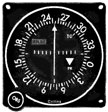 Next onto the Air Traffic Service. They use many frequencies but in particular use 108 - 137 MHz which is directly adjacent to the FM band. A report from 1997, 'Investigation of Interference Sources and Mechanisms...' showed that illegal transmitters were a constant source of interference to both navigation and communication. This is easier to understand as spurious emissions from a transmitter are usually close in frequency to the main transmission thus spurii in the band 108 - 137 MHz are not unlikely. Thus I don't necessarily doubt 'A spokesman for NATS' who said, "Unauthorised broadcasts on or close to frequencies used by air traffic controllers can interfere with the passing of vital information between air traffic controllers and pilots. They can also affect the navigation aids used as landmarks." Point to Ofcom!
"Illegal broadcasting also causes interference to legitimate radio stations, denying hundreds of thousands of listeners the opportunity to hear their favourite programmes."
Does it now? Well in some cases yes. Drive past a pirate transmitter and if you are tuned to a nearby frequency there is every likelihood that you will hear the pirate 'splattering' over the top of the station you were trying to listen to (though the same thing would also happen if you drove past a legal transmitter). However, some pirates operate 200 kHz or less away from legal stations which is insufficient to prevent such interference (legal stations typically leave a gap of 400 kHz to prevent these problems occuring). However legal stations typically use much more power than pirate stations and the effect is very localised (and anyway whose to say that your favourite programme isn't on a pirate station...)
 It is only in desperation, however, that pirates would choose a frequency likely to interfere with a legal station. In London such desparation stems from the lack of available frequencies (as most are already used by legal and other pirate stations). Given the option, most pirates choose a frequency as unlikely as possible to interfere with legal stations as it's much more likely that a complaint will be received against them if they do cause interference as if they don't.
Overall I suspect that pirate radio does cause interference in one or two cases, however in many cases it operates quite happily without causing problems to anyone else. Kudos to Ofcom for having a go at the problem, but only time will tell whether they will make any dent on the runaway train of stations that inhabit every nook and cranny of the FM band in London (and in some other major cities).
Of course there are other solutions, one being to actually licence the stations concerned and bring them into a controlled environment. Ofcom has already licensed about 30 community radio stations, however it claims that such services can only be licensed in remote areas where spare frequencies exist. A change in planning rules to recognise the low potential for interference that properly organised low-power FM stations cause might open up the band to more users and solve the pirate problem in a much more effective way.
2 comments
( 2442 views )
| permalink
| 
 ( 3 / 22180 )
( 3 / 22180 )
Bright Spark or Spark Gap?
Wednesday 30 November, 2005, 06:55 - Spectrum Management
Napoleon and the Mathematician Before going any further we need to take a brief side-step and remember Jean Baptiste Joseph Fourier (1768-1830), one time governor of Lower Egypt under Napoleon and master mathematician. Fourier developed an equation (the Fourier Transform), which allows us to transform waveforms in the time-domain into waveforms in the frequency domain. Fourier shows us that a pure sine-wave in the time-domain transforms into a single line in the frequency domain, representing the frequency at which the sine-wave oscillates (simple eh?). The converse is also true, in that a single line in the time-domain (an impulse such as is caused when lightning strikes), converts to a sine-wave in the frequency-domain – having content at virtually ALL frequencies – which is why a nearby lightning strike, which looks like an impulse in the time-domain, can affect reception on every radio receiver in a house from medium wave (~1 MHz) to television (~500 MHz) and even satellite (~10,000 MHz).
Spark Gap Transmitters
 Let's now move forward a hundred years to the work of Guglielmo Marconi (1874-1937), father of modern-day radio. During Marconi's experiments into radio transmission, oscillators producing a nice sine-wave on a single frequency weren't available. Instead, Marconi used a spark gap transmitter. This device produced an impulse (much like a lightning strike) by making a spark between two contacts and thus produced a waveform with content on all frequencies.
 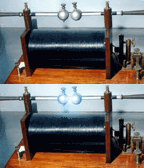 Then, using a crude tuned-circuit, the frequency that was wanted was selected. It was an inefficient way of transmitting but using high-powered sparks, high-powered signals could easily be developed – which were needed because of the poor sensitivity of the receivers. Also, due to the way in which spark-gap signals were generated, they produced a great deal of interference on many radio frequencies other than the one to which they were tuned.
As the use of radio grew, there was an increased need to separate one transmission from another to reduce interference and to that end, in 1927, the International Radio Consultative Committee (CCIR) was formed in Washington DC (these days part of the ITU). The 1927 conference also decided that the use of spark-gap transmitters would be outlawed (and they would have been completely phased-out by 1939 had World War II not started which slightly delayed their demise).
Ultra Wide Band
 Ultra Wide Band (UWB) is a relatively new term to describe a technology which had been descrined in the early 1960's as 'carrier-free', 'baseband' or 'impulse' technology. The basic concept is to develop, transmit and receive a burst of radio frequency (RF) which represent from one to only a few cycles of an RF carrier wave – effectively an impulse of RF. The resultant waveforms are extremely wide, so much so that it is often difficult to determine the actual RF centre frequency. Recent implementations of UWB do away with the idea of using an impulse to generate the signal due to difficulties in selecting the wanted frequencies, but the concept of using a transmission spread out over a very wide frequency range remains. In this sense, UWB is the modern-day equivalent of spark-gap transmitters!
The difference, however, is the power levels concerned. Whereas the spark-gap transmitters of old often used powers of 10s of kilowatts, UWB uses powers of only 10s of milliwatts (around a million times less). Further, the fact that UWB signals are purposefully spread over a very wide range of frequencies means that the actual power transmitted on any given frequency is miniscule and in many cases is below the background noise (caused by man-made, natural and even galactic sources). Conversely, spark gap transmitters were few and far between but the intention is that UWB devices will be ubiquitous. Over a country the size of the UK, where there may have been only a handful of spark gap transmitters, there may be millions of UWB devices so the potential for interference is, arguably, almost as great.
;) In order to try and prevent UWB from causing interference to other radio users, 'masks' have been set by a number of organisations from the Federal Communications Commission (FCC) in the United States to the European Telecommunications Standards Institute (ETSI) in Europe. A radio mask can be considered as similar to a mask used when printing, it prevents radio signals from being transmitted over certain areas (or reduces them) and allows them to be transmitted over other areas, in this way sensitive services (such as aeronautical radar) can have increased protection from interference. The fact that masks are necessary indicates that spectrum administrations are concerned about the interference potential from UWB, despite the very low signal levels involved.
In order to try and prevent UWB from causing interference to other radio users, 'masks' have been set by a number of organisations from the Federal Communications Commission (FCC) in the United States to the European Telecommunications Standards Institute (ETSI) in Europe. A radio mask can be considered as similar to a mask used when printing, it prevents radio signals from being transmitted over certain areas (or reduces them) and allows them to be transmitted over other areas, in this way sensitive services (such as aeronautical radar) can have increased protection from interference. The fact that masks are necessary indicates that spectrum administrations are concerned about the interference potential from UWB, despite the very low signal levels involved.Bright Spark
Counterbalancing the interference problems, however, are the benefits that UWB technology claims to offer over other, competing technologies (such as, for example, WiFi and Bluetooth). UWB claims to provide:
· Extremely high bandwidth data links (over very short ranges)
· Precision measurement and location identification (in radar applications)
· Immunity to multi-path reflections of the signal
· Low complexity and therefore (in theory) low cost
UWB is therefore well suited to applications such as high bandwidth LANs (100Mb/s+), collision avoidance sensors, precision location systems, radio tags (cargo, personnel etc), radio imaging and even low powered handheld radios. The benefits are potentially large ranging from life-saving applications to quality of life enhancing applications, but this must be balanced against the potential for interference to other radio users.
Apples and Oranges?
 Is it really fair to compare modern UWB technology with 100 year old spark-gap transmitters? Yes. And no. Yes, both transmit over a wide range of frequencies. Yes, both are based on the notion of using an impulse to generate radio signals. Yes, both have the potential to cause interference to many other radio users. No, the technology employed is fundamentally different. No, the power levels are several orders of magnitude different. No, the intended usage is different.
So what are the implications for radio users? Large numbers of UWB transmitters working together have the potential to cause interference to users across the spectrum (from around 1 to around 10 GHz for most currently planned devices). This frequency range includes a number of economically and politically important users such as mobile phones (GSM 1800, CDMA 1900 and UMTS), aeronautical and maritime radar, wireless LAN and HiperLAN, governmental and private fixed links, satellite links and in some countries wireless cable services. Despite much research in both corners of the UWB boxing-ring, there is no conclusive evidence to indicate that UWB will not cause interference to these services, then again there is no evidence that it will. Most administrations are being cautious about allowing the introduction of UWB as it's unlikely that once introduced, it would be able to be taken out of service as operation will typically be licence-exempt and thus controlling future usage will be near impossible.
For any country therefore, the decision currently exists as to whether to allow UWB services to be introduced today, delivering the kind of user benefits that the technology can provide, or whether to hold back on making that decision until there is a greater weight of international experience. Is the bright spark worth the spark gap?

Mad Hatters
Wednesday 16 November, 2005, 07:59 - Radio Randomness
According to an article in yesterday's London 'Metro' newspaper, experts from the highly respected Massachusetts Institute of Technology (MIT) have spent about US$200,000 showing that aluminium hats, similar to those worn by Mel Gibson in the film 'Signs' serve to reduce radio signals at most frequencies, but that some frequencies were amplified by the shiny metal toupees. 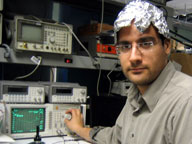 The report 'On the Effectiveness of Aluminium Foil Helmets: An Empirical Study' went on to show that the frequencies which were amplified were ones which had been allocated to the US Government and thus concluded that this was some kind of conspiracy to conduct mind control of US citizens.
However the truth about the MIT study is rather different. The students used equipment worth US$250,000 (rather than spending that much) in the form of a network analyser to determine the gain of the 'hat' at different frequencies. They concluded that the hats had peaks in gain at 1.2 and 2.6 GHz (not surprising if one does a few simple sums concerning the typical size of a human head and the frequency at which such hats would naturally resonate) and went on to conclude that as the first of these frequencies was used by GPS satellites broadcasting Government signals from the sky, that the hats may well increase the Government's invasive abilities.
If this were to be the case, then the US Government would have to emit high power 'mind-altering' signals on those frequencies. However, much more importantly, they would have to make all the citizens wear silly aluminium hats, which as far as I am aware is not yet mandatory (except, presumably, at some of the more wacky parties at MIT!)
Further, GPS satellite signals are very weak compared to the extremely high-powered
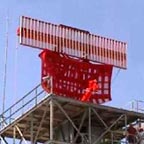 aeronautical radar systems that share the frequencies around 1.2 GHz, so if any signal were likely to affect the wearer it would be those coming from the radars at airports (and the corresponding transponders on aircraft). Aeronautical radars (both civil and military) also occupy frequencies beginning at 2.7 GHz (very close to the other measured gain hot-spot).
  Could this explain the increase in the number of air travellers around the world? Or might it explain why, after a long flight, you feel dazed as you depart the airport? Or is this a conspiracy to increase the sales of duty free?
Why not try wearing one of the hats the next time you visit an airport and see if you can note any unusual effects? Remember not to take it off when you pass through the airport scanners, otherwise the experimental value of the research will be lost. Wearing camouflage, a head scarf and carrying a replica AK-47 are also known to enhance the effectiveness of such airport-based experiments and often make the results more immediate and obvious.
CDMA: How does that work then?
Tuesday 15 November, 2005, 07:44 - Spectrum Management
CDMA - Code Division Multiple Access - is probably one of the most complex methods for accessing the radio spectrum that is in use today. Let's first take a look at the easier to understand methods to see what the differences are.FDMA - Frequency Division Multiple Access - is a system whereby different users use different frequencies at the same time. Imagine tuning up and down the FM dial, there are lots of stations you can hear but you can separate one from the other by tuning into the different frequencies that each uses. If two occupy the same frequency at the same time, they cause interference to each other and the whole thing falls to pieces.
TDMA - Time Division Multiple Access - is a system whereby different users use the same frequency at different times. So a number of users messages are scheduled one after the other, so that they can all share the same frequency. Imagine a lot of letters passing along the conveyor belt in a postal sorting office. Each message passes after the other along the same conveyor and can be sorted out back into individual messages for delivery. If two letters were to be in the same place at the same time they would crash into each other and the system would fail. From a radio perspective this works only if you take the message concerned and 'squash' or 'compress' it into less time than it would normally take so that at the receiving end it can be de-compressed to fill in the gap that is produced whilst the other messages are being sent.
CDMA is a system whereby all the users use the same frequency at the same time. How can this possibly work without interference being caused? It works by assigning each message a unique code. Think of it as assigning each message a different language and then place yourself in a room where you can hear all the messages together - the one you immediately understand is the one in the language you speak. So if you hear 'Je m'appelle Colin', 'Ich heisse Lyon' and 'My name is Derek', all spoken at the same time, the clearest message is the one in your native language. However this only works if all the messages are roughly the same volume (and in fact works best if all the messages are exactly the same volume), if one language is shouted a lot louder than the others, it inevitably swamps the listener so that he can no longer hear his natural language.
As such, one element of a CDMA radio system is that the receiver (listener) needs to inform all the transmitters (speakers) how strong their signal is (how loud they are being heard) so that the transmitters can adjust their transmitter power (volume) to allow the receiver to hear them all at the same strength. This system of 'power control' is one of the key technologies that allows CDMA systems to operate.
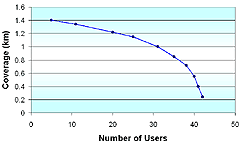 CDMA receivers also suffer from something called 'cell breathing'. Imagine that you can hear 4 different languages, the chances are that you will hear the one you understand quite easily. Now imagine you can hear 64 languages, it becomes much more difficult to hear your native language. So the more transmitters sharing the same frequency, the harder the receiver has to listen. To compensate for this, receivers move closer together and further apart each and every second to make sure that they are sufficiently near to those transmitters they are receiving to hear them well. Clearly this is not possible and what happens is that the coverage of the cell shrinks when it is heavily loaded, complicating coverage planning.
All this being said, CDMA is reckoned to be around twice as spectrally efficient as either TDMA or FDMA techniques, meaning twice as much traffic (data) can be carried in a given amount of spectrum.
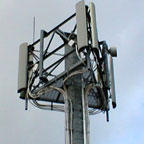 It is no surprise, therefore, that all of the competing third generation (3G) mobile phone technologies use CDMA: the US-based CDMA-1x series of specifications designed by Qualcomm; the European W-CDMA (Wideband-CDMA) or UMTS (Universal Mobile Telecommunications System) system; and the Chinese TD-SCDMA (Time Division-Synchronised CDMA) system.
What's interesting is that although all 3G mobile technologies use CDMA, other mobile technologies (such as Digital Audio Broadcasting, Wireless LAN and HiperLAN) have forgone the use of CDMA and instead use another spectrum access technique called OFDM - Orthogonal Frequency Division Multiplex. But that's a story for another day.